Hormone-Free Birth Control – Copper IUD, Barrier, and Natural Methods
Hormone-Free Birth Control – Copper IUD, Barrier, and Natural Methods
Safe ContraceptiveMethods Without Hormones
Not every woman wants to use hormonal birth control—whether out of personal conviction, due to side effects, or because hormones aren’t right for her health. The good news: There are safe, hormone-free options. First things first, because this is key to making the right choice: Reliability ranges from very high—with the copper IUD—to significantly less reliable with natural methods. Understanding this range will help you choose a method that truly fits your lifestyle. Together, we’ll figure out which one is right for you.
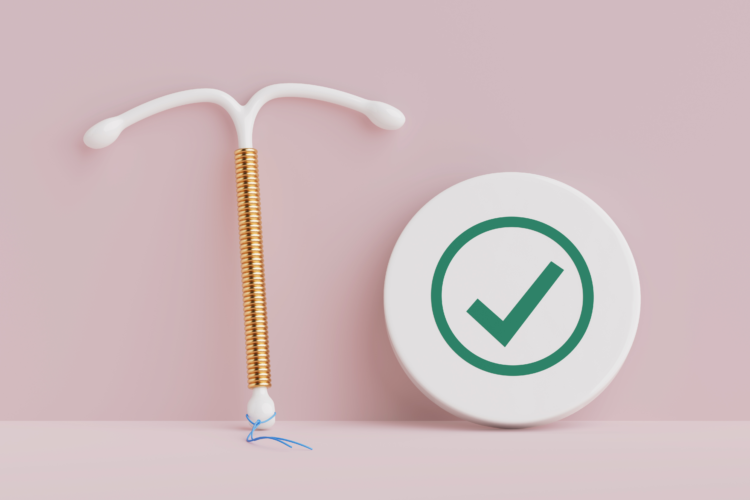
The copper IUD is a small plastic device with a fine copper wire that is inserted into the uterus. The copper immobilizes the sperm, thereby preventing fertilization—without any hormones at all. Depending on the model, it provides protection for five to ten years.
It’s one of the safest methods available because, once inserted, there’s nothing else you need to do and nothing you can forget—only about one in a hundred women still becomes pregnant each year. It’s suitable for women of all ages, including young women who haven’t had children. Its main drawback: menstrual bleeding often becomes heavier, longer, and more painful—for some women, this is the reason they have it removed. Smaller models are available for women with a smaller uterus.
A particular advantage: The copper IUD is also the most effective form of emergency contraception. When inserted up to five days after unprotected sex, it prevents pregnancy with near certainty—more reliably than any “morning-after pill” (Cleland et al. 2012). Conveniently, it continues to provide protection for the next few years.
The condom is the only form of birth control that also protects against sexually transmitted infections. When used perfectly, it is quite safe (about two out of every hundred women per year), but in everyday use, the rate is significantly lower—because it can slip off, break, or be forgotten, the rate rises to about eighteen out of every hundred. It is ideal for new relationships and as a supplement to a second method.
The diaphragm and cervical cap are flexible caps that are placed over the cervix along with a gel before intercourse. They are hormone-free and reusable, but must be fitted and positioned correctly each time—their reliability is moderate and depends heavily on correct use.
The female condom is inserted into the vagina as a soft tube and also protects against infections; it takes some getting used to. Spermicides (sperm-killing gels) alone are too unreliable and should only be used as a supplement.
With natural methods, the woman determines her own fertile days and either abstains from intercourse or uses a barrier method. The most reliable method is the symptothermal method, which combines two bodily signs: the morning basal body temperature and cervical mucus. When used very carefully and consistently, it is surprisingly reliable—in a large study, fewer than one in a hundred women per year became unintentionally pregnant (Frank-Herrmann et al. 2007).
To be honest, though, this only applies if the method is used consistently. In everyday life—with stress, illness, an irregular cycle, and intercourse on borderline days—significantly more women become pregnant; in some studies, the rate is around twenty out of every hundred per year. Cycle apps can help with interpretation, but they are no substitute for the necessary knowledge or daily discipline. The advantages are real: no side effects, minimal cost—and the same knowledge will come in handy if you ever decide you want to get pregnant. These methods work best for women with a reasonably regular cycle, a stable relationship, and the willingness to engage with the process daily.
We advise against relying solely on “withdrawal” (withdrawing before ejaculation)—it’s very unreliable and not a dependable form of birth control.
Once you’re certain you’re done having children, sterilization is a very safe, permanent solution. It cannot be reliably reversed—so it should only be considered if you’re absolutely certain of your decision.
For women, the fallopian tubes are now usually removed entirely (salpingectomy) rather than simply being cut. This is just as safe and has an additional benefit: it significantly reduces the risk of ovarian cancer, because many of these tumors originate in the fallopian tubes (FIGO 2024). The procedure is performed via laparoscopy under brief anesthesia, usually on an outpatient basis.
For men, a vasectomy is the simpler, safer, and more affordable procedure—performed under local anesthesia by a urologist. As a couple, it’s worth taking the time to compare both options. We do not perform the procedure ourselves: We’ll discuss everything with you, refer you to the right specialist, and continue to support you throughout the process.
The copper IUD and sterilization are the most reliable methods because nothing can go wrong with them. With barrier and natural methods, effectiveness depends heavily on how consistently they are used. The Pearl Index shows how many women still become pregnant with each method, and we’d be happy to go over it with you during our consultation.
In Switzerland, contraception is generally a private matter and is not covered by basic health insurance. The copper IUD costs a few hundred francs, including insertion, but then lasts for years. Condoms are inexpensive per piece, and natural methods are almost free (at most, a thermometer or an app). Female sterilization costs around 2,000 francs or more, while a vasectomy for men usually costs less than 1,000 francs. We’ll discuss the costs openly with you.
An important point: Neither the copper IUD, nor natural methods, nor sterilization protect against sexually transmitted infections. Only condoms offer this protection. If you’re not in a mutually faithful, tested relationship, it’s best to combine your birth control method with condoms.
Hormone-free doesn’t necessarily mean less reliable—the copper IUD is one of the most reliable methods available. It simply means we’ll take a close look at what’s right for you. How reliable it needs to be, how much effort you’re willing to put into it on a daily basis, and whether you’re done having children—these factors will determine the right method for you.
More articles
on this topic
No posts found.
Medical content reviewed by Michael Singer, M.D. –