Egg Collection and Embryo Transfer
Egg Collection and Embryo Transfer
Key Steps
towards Success
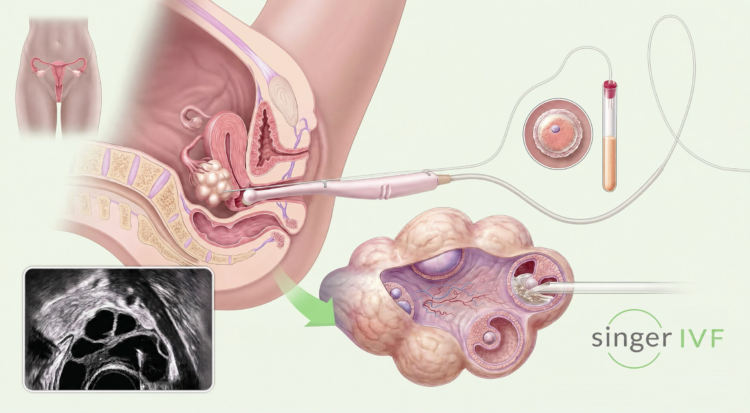
As soon as the biggest ovarian follicles have reached 17-20 mm on ultrasound, we trigger ovulation by means of a last timed injection in the evening. Two nights (36 hours) later, you will come fasting to our clinic in the morning, together with your husband/partner. The collection is performed ultrasound-controlled through the vagina in a ultra-short general anesthesia of approx. ten minutes (see picture above), and the eggs are handed over to the biological team in their follicular fluid. Afterwards, you will wake up in your patient room, will get breakfast, and Dr Singer will tell you how many eggs we could find.
We consider the transfer of one single embryo back into the woman’s uterus to be one of the keys to success. In keeping with our philosophy, embryo transfer should be painless, relaxed, and somewhat ceremonial; after all, the goal is to make the rather technical process of IVF as humane as possible. The husband or partner should be present whenever possible so that the couple can experience this magical moment together.
A half-full bladder (shown in black in the image above) allows us to visualize the uterus via ultrasound from the abdomen during the transfer. It also pushes the uterus backward and downward, thereby reducing the curvature of the cervix so that the soft catheter (white line in the image above) can pass through more easily. Once the correct position is achieved, the embryo is gently transferred from the syringe into the uterus. We often then see an air bubble at the very top of the uterus. The entire procedure requires the woman to be relaxed and the doctor to be skilled.
The partially filled bladder (black in the image above) allows us to visualize the uterus with ultrasound from the abdomen during the transfer. It also pushes the uterus backward and downward, thus reducing the curvature of the cervix, making it easier for the soft catheter (white line in the image above) to pass through. Once the correct position is reached, the embryo is gently transferred from the syringe into the uterus. We often see an air bubble at the top of the uterus at this point. The entire procedure requires relaxation from the woman and skill from the doctor.
After the embryo transfer, the woman should not remain lying down. Instead, we send the couple for a walk along the shores of Lake Zurich. Afterward, we recommend that they resume their normal daily activities, refraining only from extreme physical exertion. By consistently applying this philosophy without exception, we achieve our very high success rates.
The waiting period between embryo transfer and the pregnancy test is considered by the majority of couples to be the most stressful part of the entire treatment, and work is often the best source of the necessary distraction.
More articles
on this topic
No posts found.
Medical content reviewed by Michael Singer, M.D. –