Endometriosis – When Uterine Lining Spreads
Endometriosis – When Uterine Lining Spreads
Endometriosis – Common Yet Often Misdiagnosed
Endometriosis is common—yet it often goes undiagnosed for years. Many women are told for a long time that they “just have severe period cramps” until the diagnosis is finally made. We want to change that: We take your pain seriously, conduct targeted evaluations, and provide effective treatment. Endometriosis doesn’t just go away like a cold—but it’s highly treatable, and you don’t have to put up with the pain as if it were normal.
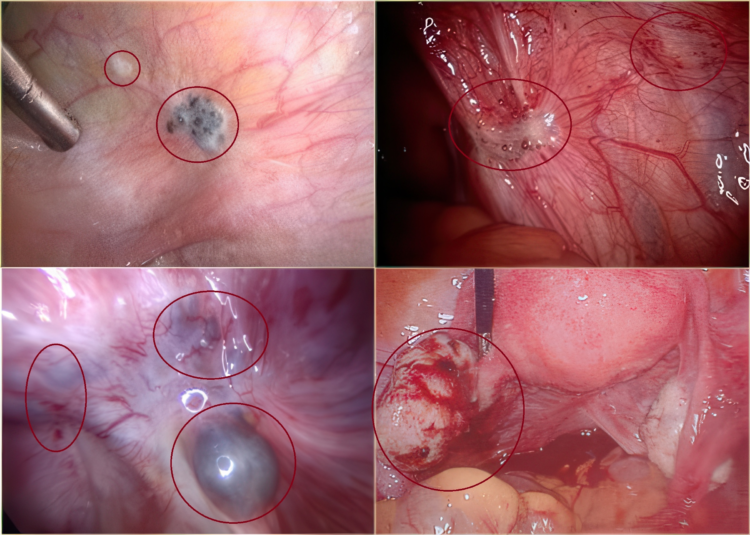
In endometriosis, tissue similar to the uterine lining implants itself outside the uterus—for example, on the peritoneum, the ovaries, or the ligaments supporting the uterus. This tissue follows the monthly cycle: it bleeds, but the blood cannot drain away. The result is chronic inflammation accompanied by pain, adhesions, and scarring. It is estimated that about one in ten women is affected (ESHRE 2022). Important: The extent of the endometriosis says little about the severity of the symptoms—some women with extensive lesions experience little discomfort, while others with small lesions suffer greatly.
If this tissue is located within the muscular wall of the uterus itself, the condition is called adenomyosis. It primarily causes heavy, painful, and often prolonged menstrual bleeding as well as a feeling of pressure, and can now be easily detected via ultrasound. It is treated similarly to endometriosis; for bleeding disorders, a hormonal IUD is often sufficient (more on this → “Menstrual Cycle and Bleeding Disorders”).
Endometriosis manifests in a wide variety of ways. Typical symptoms include:
Less commonly, cyclical symptoms may occur in unusual locations (such as shoulder or scar pain). If you recognize these patterns in yourself, please talk to us—the sooner we can investigate, the better. By the way, endometriosis can begin as early as the teenage years: Severe menstrual cramps in young women should be taken seriously and investigated (more on this → “Teen Clinic”).
For a long time, it was believed that only laparoscopy could provide a definitive diagnosis. That’s no longer the case. Today, we start with a detailed discussion about your pain and often make a preliminary diagnosis based on clinical findings alone. Ultrasound reveals many lesions, cysts on the ovaries (endometriomas), and deeper findings; if necessary, we supplement this with an MRI (ESHRE 2022). Non-invasive saliva tests are currently being evaluated but are not yet sufficiently validated to replace established diagnostic methods. Laparoscopy is now performed only in specific cases—when imaging results are inconclusive or treatment is planned anyway—and no longer solely for diagnostic purposes.
Treatment is tailored to what is causing you distress and what you hope to achieve—pain relief, family planning, or both. We choose the approach together, often combining methods:
Endometriosis and infertility do not necessarily go hand in hand—many women with endometriosis become pregnant, either spontaneously or with assistance. If you’re hoping to have children, we’ll create a personalized plan and coordinate your pain management with your family planning goals. For more details, see → “Endometriosis and Family Planning.”
The course of the condition is difficult to predict: Some women remain symptom-free for a long time after treatment, while others experience recurring episodes. Following surgery, hormonal therapy helps prevent a relapse (ESHRE 2022). We’ll stay by your side and adjust your treatment over the years—so that you can live with as few symptoms as possible and maintain a sense of self-determination.
More articles
on this topic
No posts found.
Medical content reviewed by Michael Singer, M.D. –