Basic Evaluation
Basic Evaluation
Important Tests
for Men and Women
After the initial consultation, the actual evaluation begins. This generally includes both partners and is intended to be comprehensive—if one problem is discovered, it’s common for us to find a second or third as well.
First, we review what’s already known. If you’ve already been evaluated by your gynecologist, primary care physician, or a urologist, we’ll incorporate those findings and build on them. We’ll only repeat tests that are truly necessary for further planning—for example, if a test result is quite old. We’ll discuss this with you each time so you understand why repeating a test makes sense.
At the beginning of your cycle (days 2–5), we draw blood and measure various hormones. These give us an idea of how your ovaries are functioning and whether your hormone levels are balanced.
One value often receives special attention: AMH (anti-Müllerian hormone). It provides an indication of the egg reserve—that is, roughly how many eggs are still available. It’s important to note what AMH does not indicate: It says nothing about the quality of the eggs and nothing about the likelihood of a natural pregnancy. A low level does not mean it won’t work, and a high level is no guarantee. It is one piece of the overall picture—nothing more, nothing less. To learn how egg reserve and age are related, read our article “Age and Fertility.”
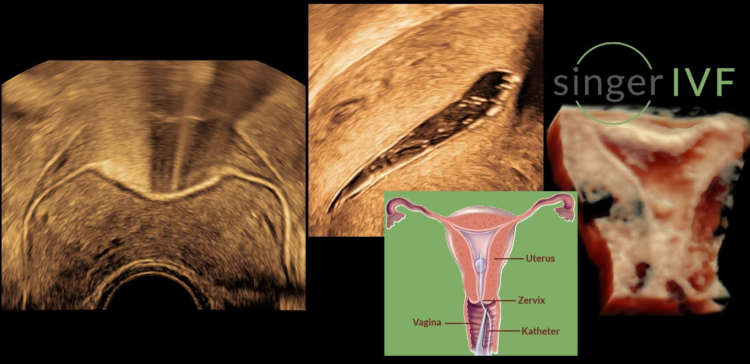
[Image placeholder: Contrast ultrasound – procedure / catheter placement]
For men, we assess sperm quality. You can provide the sample at our clinic or collect it at home and bring it with you—whichever is more convenient for you. The only important thing is that it reaches the lab promptly.
Our embryologists then evaluate the sample based on the following criteria: sperm count, motility, and morphology.
[Image placeholder: Sperm analysis – Evaluation in the lab]
If the semen analysis reveals abnormalities or if there are indications from your medical history, a urological examination is the next step. It is not necessary for every man—we arrange it specifically when it helps clarify the situation.
Because the tests for women are tied to the menstrual cycle, they are spread out over about a month: the blood draw early in the cycle, the ultrasound around the middle of the cycle. The semen analysis is independent of this and can be performed at any time. This means that the key results are available after about one cycle.
For most couples, this initial evaluation is sufficient to plan the next steps. Sometimes more specific tests are needed—such as a hysteroscopy or laparoscopy if findings suggest it, or additional blood tests for certain pre-existing conditions. This is the exception, not the rule, and we’ll discuss it with you before taking such steps.
Once all the results are in, we’ll meet again to discuss the findings and work together to determine your next steps.
→ Learn more on our “Family Planning Treatments” page

Schedule an Appointment
Please contact us. We’d be happy to assist you personally.
More articles
on this topic
No posts found.
Medical content reviewed by Michael Singer, M.D. –