Infertility
as a result of endometriosis
Infertility
as a result of endometriosis
Inability to achieve family planning
as a result of endometriosis
Many women with endometriosis worry that they might not be able to have children. First, the most important thing: A great many women with endometriosis do get pregnant—often naturally. Endometriosis can affect fertility, but it doesn’t have to. On this page, we’ll take an honest look at how endometriosis affects fertility, what really helps—and what doesn’t. You can read more about the condition itself on our page → “Endometriosis.”
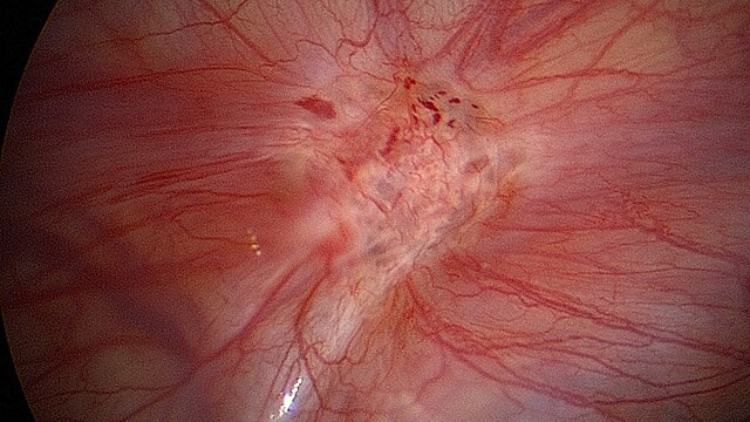
Endometriosis can make it harder to conceive in several ways: Chronic inflammation in the pelvis alters the environment for eggs and sperm; adhesions can block the fallopian tubes; cysts on the ovaries (so-called “chocolate cysts”) can disrupt ovulation and the egg reserve; and egg quality can also be affected. A specific form, adenomyosis (endometriosis within the uterine muscle), can also make it more difficult for the embryo to implant. Important to know: The extent of endometriosis, the severity of pain, and its impact on fertility do not necessarily go hand in hand. A woman with extensive lesions may conceive easily, while another with minimal visible endometriosis may struggle with family planning.
Endometriosis is common—about one in ten women is affected, and the rate is significantly higher among women struggling with family planning. And it often goes undiagnosed for a long time: It’s not uncommon for years to pass between the first symptoms and diagnosis, because severe menstrual cramps are often dismissed as “normal” for a long time. If you suffer from severe pain before and during your period, pain during sex deep in the pelvis, or difficulty with family planning, it’s worth getting a targeted evaluation—the sooner, the better.
The first clues come from discussing your symptoms and an ultrasound exam, which is particularly effective at detecting ovarian cysts and deep-seated lesions. Laparoscopy was long considered the only way to make a definitive diagnosis. Today, we often make the diagnosis based on your symptoms and an ultrasound—and we no longer perform laparoscopy “just to take a look,” but only when it also provides a treatment.
We want to be especially honest here, because surgery in particular is often accompanied by high hopes—sometimes more than the data supports.
There is only weak evidence that surgery improves natural fertility. Older studies suggest a slight benefit, if at all, primarily in cases of very mild endometriosis. In contrast, for advanced endometriosis or chocolate cysts, surgery does not reliably improve the chances of conception—on the contrary: removing an ovarian cyst almost always also removes healthy ovarian tissue, thereby reducing the egg reserve (overview).
This is even more clearly true for family planning: There is no evidence that surgery prior to artificial insemination improves its success rate. The current guideline explicitly advises against routine surgery prior to IVF (ESHRE 2022). We therefore do not perform surgery as a reflex, but only when there is a specific reason—such as severe pain, a very large cyst that hinders egg retrieval, or an unclear diagnosis. Even medical suppression of ovarian function alone does not improve fertility.
We never make this decision mechanically, but rather calmly in consultation with you—with the goal of protecting your fertility, not harming it.
Which path is right depends on your age, the test results, and your egg reserve. For young women with mild endometriosis, it may make sense to first try conceiving naturally or with ovulation induction and insemination (more on this → “Ovulation Induction and Insemination”). In many cases, however, in vitro fertilization (IVF/ICSI) is the most effective approach—especially if the egg reserve is diminished, the fallopian tubes are affected, or time is of the essence. IVF bypasses many of the problems caused by endometriosis in the pelvis and achieves good success rates even in cases of endometriosis.
If the egg reserve is at risk due to endometriosis—or due to a necessary surgery—it may make sense to freeze eggs early on as a precaution for the future. This is particularly relevant when you’re not yet ready for family planning, but a chocolate cyst or a planned procedure is putting your egg reserve at risk (more on this → “Egg Preservation”).
Endometriosis and family planning are a double burden. Keep this in mind: A diagnosis of endometriosis does not mean you won’t be able to conceive—many women with endometriosis do go on to have children. We’ll support you on this journey, both medically and emotionally (more on this → “The Emotional Side of Family Planning”).
More articles
on this topic
No posts found.
Medical content reviewed by Michael Singer, M.D. –