IVF and ICSI
IVF and ICSI
In-vitro-Fertilisation (IVF) and Intracytoplasmic Sperm Injection (ICSI)
Natural human fertilization in the Fallopian tube implies that the sperm cell, after a long and exhausting swim, must penetrate the - sometimes rigid - shell of the human egg (zona pellucida). If male fertility is reduced, and also in cases of unexplained subfertility, this crucial part of human fertilization may not happen, or happens too seldom. Even conventional IVF, where the egg is incubated with some ten thousands sperm cells overnight, fails to achieve fertilization in 5-10% of cases.
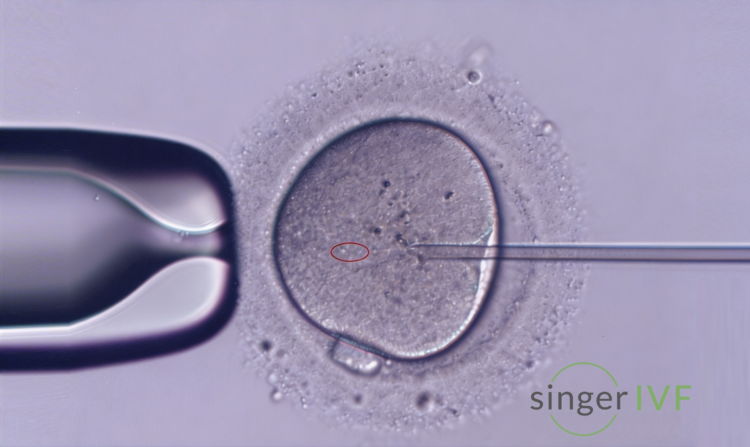
In 1992, the IVF method underwent a decisive advancement in Brussels. In ICSI, a single sperm cell is injected directly into the cytoplasm (cell fluid) of the egg using a microneedle (inner diameter 0.005 mm!).
From the left, the holding pipette is securing the egg (oocyte); from the right, the injection pipette just pierced the tough outer layer (zona pellucida) and the cellular membrane of the oocyte. In reality, the sperm cell is way smaller than above. This process is repeated for every mature egg; the eggs were collected some hours earlier from the ovaries of the woman.
Left: mature egg (oocyte) after egg collenction (day 0),
Center: fertilized oocyte (zygote) with two central pronuclei and two polar bodies on day 1,
Right: ten-cell embryo on day 3.
On day 5, the fertilized egg has divided into some 200 cells, which form a wonderful hollow sphere (blastocyst) with an inner cell mass (red), which will give the baby, and an outer layer (trophectoderm), which will produce the placenta. On top, the embryo starts the hatching process from its shell.
An almost spiritually beautiful blastocyst, pictured by our head biologist Dr Agudo.
More articles
on this topic
No posts found.
Medical content reviewed by Michael Singer, M.D. –