Menstrual and Bleeding Disorders
Menstrual and Bleeding Disorders
Menstrual Cycle:
When Is It Normal, When Is It Abnormal?
Every woman’s cycle is different—and it changes over the course of her life. If your period suddenly becomes too heavy, too frequent, too infrequent, or irregular—or stops altogether—there’s almost always a clear cause behind it—and the vast majority of these causes are harmless and easily treatable. On this page, we’ll explain when bleeding is “out of the ordinary,” what might be causing it, and what options are available. We’ll then work with you to find the right solution.
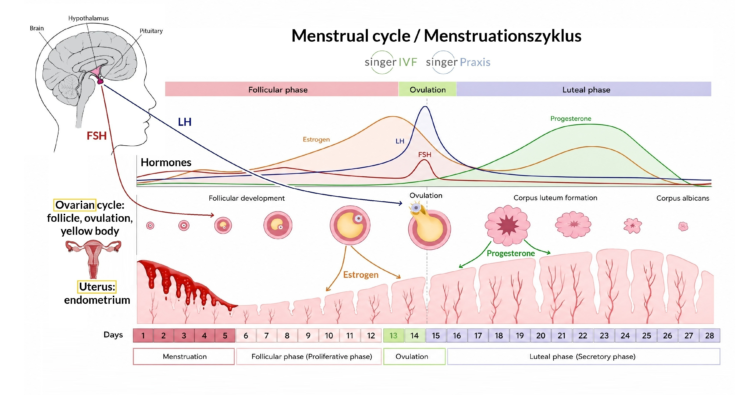
Today, a cycle is considered normal if it occurs approximately every 24 to 38 days, menstrual bleeding lasts up to 8 days, and the flow remains roughly consistent in both heaviness and regularity (Munro et al. 2024). Bleeding is considered “out of the ordinary” especially if it
Important: It’s not the absolute amount that matters, but whether the bleeding is causing you distress or limiting your daily life. In the first few years after your first period, your cycle needs time to settle into a regular pattern, and shortly before menopause, it often becomes more irregular again—both are normal and usually no cause for concern.
Please contact us promptly—not just at your next routine appointment—if you experience bleeding after menopause, bleeding after sexual intercourse, very heavy or persistent bleeding, or signs of anemia (fatigue, paleness, shortness of breath during exertion). We’d be happy to evaluate these situations quickly.
To identify the cause, we look at two groups (in medical terminology, according to the FIGO “PALM-COEIN” classification):
Both types can occur, sometimes even together—which is why we conduct a targeted evaluation before beginning treatment.
If your period is absent for an extended period and you are not pregnant, this is a separate issue requiring its own evaluation. There can be a wide variety of underlying causes—ranging from stress, intense physical exertion, or weight changes to hormonal and thyroid disorders, all the way to the onset of menopause. If the condition persists, we’ll take the time to determine the cause; after all, a prolonged estrogen deficiency can weaken the bones over time.
We start with a conversation: What does your cycle look like, what’s causing you stress, and what are your goals—for example, regarding birth control or family planning? This is usually followed by an ultrasound and a blood test; depending on the situation, we check your hormone levels, rule out pregnancy, and, if necessary, take a small tissue sample from the uterine lining. This allows us not only to identify common, harmless causes but also to reliably rule out rarer, more serious ones.
The appropriate treatment depends heavily on the cause and your preferences—whether you’d like to use contraception, are interested in family planning, or would prefer to avoid surgery. That’s why we develop the treatment plan together with you. Broadly speaking, there are three approaches that we use individually or in combination:
More articles
on this topic
No posts found.
Medical content reviewed by Michael Singer, M.D. –