Pregnancy – Non-Invasive Prenatal Test (NIPT)
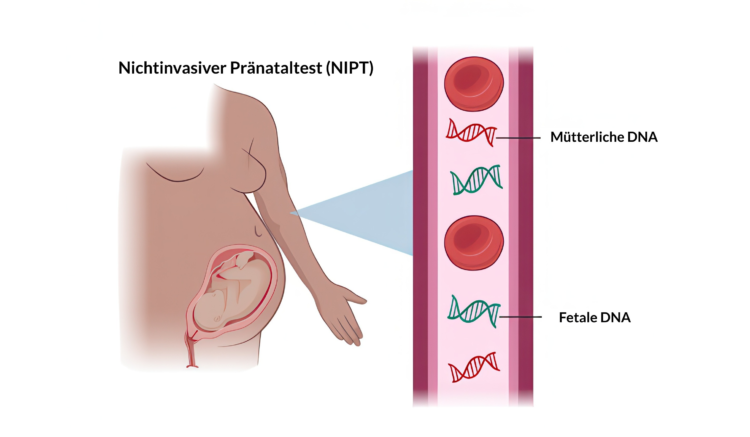
Pregnancy – Non-Invasive Prenatal Test (NIPT)
A blood test for chromosomal abnormalities
The NIPT (non-invasive prenatal test) is a simple blood draw from the mother that allows for a highly accurate assessment of the most common chromosomal abnormalities in the fetus. It can be performed starting in the 10th week and poses absolutely no risk to the pregnancy—all it takes is a small blood sample. Important to know: NIPT is also a screening test, not a definitive diagnosis. Like all prenatal tests, it is voluntary (more on this → “Prenatal Tests”).
Tiny fragments of genetic material from the placenta circulate in the blood of every pregnant woman; we use these as a reflection of the baby’s genetic makeup. NIPT analyzes these fragments and determines whether there are too many or too few copies of a particular chromosome. Results are usually available within one to two weeks. In rare cases, the test does not yield a valid result—for example, if there is too little fetal DNA in the blood (more common very early in pregnancy or in women with a higher body weight); in such cases, we repeat the blood draw.
NIPT is most reliable for the three common trisomies—trisomy 21 (Down syndrome), 18, and 13: Here, its accuracy exceeds 99 percent (ISPD 2023). We generally recommend the extended NIPT, which analyzes all 22 chromosomes and the sex chromosomes, for an additional fee of 250 Swiss francs. NIPT is also possible for twins, though with certain limitations.
The order is important: A normal ultrasound is the basis for a meaningful NIPT. We therefore do not recommend the NIPT before the nuchal translucency ultrasound (weeks 11 to 14). If the ultrasound already shows an abnormality—such as a significantly increased nuchal translucency—the NIPT is not the right next step; in which case a more detailed evaluation or even an amniocentesis makes more sense. NIPT does not replace the ultrasound, but rather complements it. This is because NIPT examines the chromosomes, not the child’s physical structure: abnormalities such as a heart defect or spina bifida can only be detected by ultrasound.
Beyond the three trisomies, there are advanced testing options: These also look for small missing pieces of genetic material (microdeletions) or screen the entire genome for larger changes. This allows for a more comprehensive assessment. It’s important to note: With these rarer findings, an abnormal result is more often a false alarm and must always be confirmed by amniocentesis; furthermore, the advanced tests are not covered by health insurance (ISPD 2023). We’ll discuss with you which option makes the most sense for you.
As accurate as NIPT is, an abnormal result must be confirmed by amniocentesis or chorionic villus sampling before any far-reaching decisions are made (→ “Amniocentesis”). This is also because the test analyzes the genetic material of the placenta, which in rare cases may differ from the child’s genetic material (a condition known as mosaicism). Only an amniocentesis or chorionic villus sampling can provide a definitive diagnosis.
In Switzerland, the first-trimester test is usually performed first (→ “First-trimester test”). If it indicates an elevated risk (greater than 1:1,000), basic health insurance covers the standard NIPT for common trisomies. Otherwise, you can pay for it yourself as an elective service (approximately 500 to 800 francs, depending on the test). We’ll take the time to discuss with you what makes the most sense for you.
More articles
on this topic
No posts found.
Medical content reviewed by Michael Singer, M.D. –