First-Trimester Screening and Nuchal Translucency
First-Trimester Screening and Nuchal Translucency
Risk Assessment for ChromosomalAbnormalities
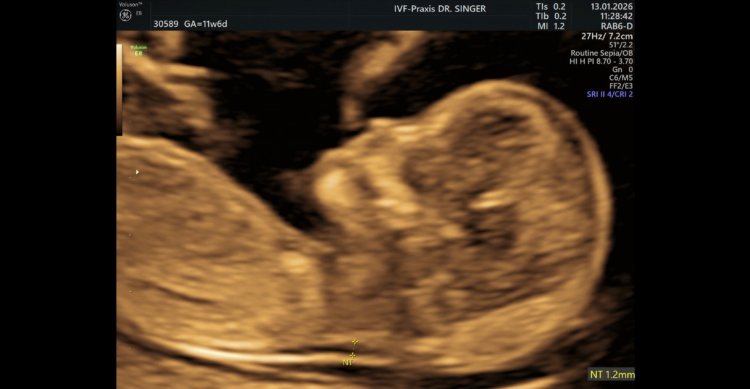
The first-trimester test is a risk assessment performed early in pregnancy. Between the 11th and 14th weeks, it combines an ultrasound measurement—nuchal translucency—with two blood test results and your age to estimate the likelihood that your baby has one of the common chromosomal abnormalities. Important to know: It provides a probability, not a diagnosis. Like all prenatal tests, it is voluntary (more on this → “Prenatal Tests”).
In every pregnancy, a thin layer of fluid accumulates in the nuchal region during early pregnancy—this is known as nuchal translucency. A thin layer is completely normal. If it is significantly thickened, this may indicate a chromosomal abnormality or another abnormality. The measurement requires experience and a high-quality ultrasound machine and can only be performed within a narrow time window—between the 11th and 14th weeks.
In addition, we measure two values in your blood (PAPP-A and the pregnancy hormone β-hCG). Based on these blood levels, the nuchal translucency measurement, and your age, we calculate your personal risk for trisomy 21 (Down syndrome) as well as for the rarer trisomies 18 and 13. The result is a number—for example, 1:2000 or 1:150—rather than a simple “yes” or “no.” The combined test detects about 90 out of 100 pregnancies with trisomy 21 (ISUOG 2023); it does not detect all of them, and sometimes the risk is indicated as elevated even though the child is healthy.
Nuchal translucency reveals more than just the risk of trisomy: if it is significantly thickened, this can indicate a heart defect or another developmental disorder even if the genetic material is completely normal (Sotiriadis et al. 2013). In this case, we examine the child’s heart and organs particularly carefully and, if necessary, consult a prenatal center.
A low risk is reassuring—in most cases, no further testing is necessary. If the risk is higher (above 1:1000), we’ll discuss the next steps with you: an NIPT, a blood test that assesses the common trisomies even more accurately (→ “NIPT”), or—in cases of very high risk or if you want certainty—an amniocentesis or chorionic villus sampling, for which we will refer you to a prenatal diagnostic center (→ “Amniocentesis”). You decide which path to take; we’ll advise you at your convenience.
The first-trimester test takes place between the 11th and 14th weeks and is covered by basic health insurance. The results are usually available within a few days.
More articles
on this topic
No posts found.
Medical content reviewed by Michael Singer, M.D. –